

In this issue, we see the Beetle, freshly released from jail and on a mission for vengeance, targeting none other than the Human Torch, a.k.a. Johnny Storm. Interestingly, while Johnny is out on a date with Doris Evans, he leaves abruptly to search for the Beetle, concerned that his old foe may be up to no good. This understandably frustrates Doris, who later insists that Johnny refrain from “flaming on” for 24 hours if he wants their relationship to continue.
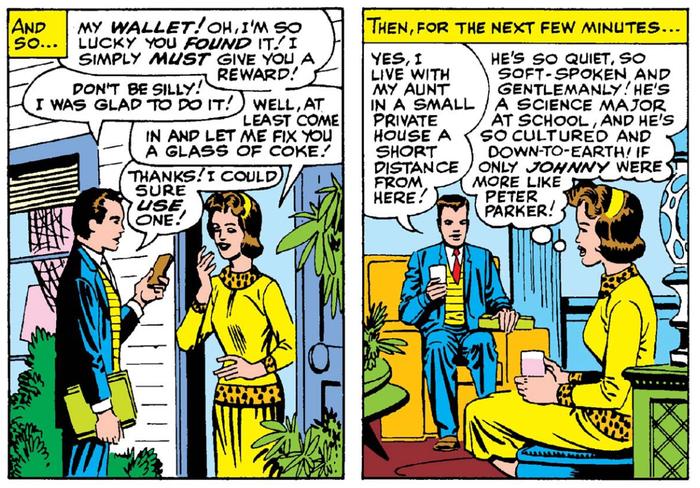
So, where does our main protagonist, Spider-Man, fit in? As longtime readers know, Spider-Man and the Human Torch have an ongoing rivalry that’s been showcased several times already. This time, Spider-Man encounters Doris on the street, finds her wallet, and returns it to her home—a seemingly minor act that Doris seizes upon to make Johnny jealous. This results in Johnny confronting Peter Parker, leading to Betty Brant getting upset with Peter, mistakenly thinking he’s cheating on her.
While in an effort to get even, Spider-Man and the beetle collide in combat, that eventually leads to The Human Torch joining in…
Story
This story didn’t fully grab me. The Human Torch has been showing up in Spider-Man comics quite a bit; in fact, out of 22 issues, including the annual, he’s appeared in 8, or about one-third. While shared-universe crossovers can add depth, I found myself thinking, “Not again.” The action scenes, though somewhat engaging, often felt forced and didn’t always respect established character continuity.
Moreover, one of the greatest strengths of Spider-Man stories—the depth of Peter’s supporting cast and the delicate balance between his life as Peter and his life as Spider-Man—was only hinted at here, not explored in any meaningful way. This story might have been better suited as a solo Human Torch feature.
Characters & Development
The most significant character development here is that Betty is once again mad at Peter, adding to the ongoing “on-again, off-again” nature of their relationship. One of the hallmarks of Spider-Man comics is Peter’s constant struggle to maintain a “normal” life despite his responsibilities as a hero. But here, the conflict with Betty feels more like a rehashed trope, falling into the predictable “of course there’s trouble” category rather than adding fresh tension.
Originality & Continuity
This issue feels like a familiar mix of old themes rearranged in a new way. While recycled elements are common, they usually feel engaging; here, they fall flat, making the issue feel skippable rather than essential.
Artwork
Unfortunately, the artwork didn’t stand out for me either. At best, some panels were serviceable and met expectations, but others felt lackluster and even subpar in places.


Leave a Reply