

What we have here, hot on the heels of the story in Fantastic Four #37, is another appearance of NASA—though this time, they play a bigger role. One Mr. Pearson of NASA approaches the Fantastic Four for help in uncovering a suspected traitor within their ranks. Sounds thrilling, right? Well, hold that thought.
For this mission, not all members of the Fantastic Four are suited to the task. Mister Fantastic is deemed too recognizable for undercover work (world famous scientist and all), and the Thing? Forget about it—he’s not exactly inconspicuous. As for Sue Storm, she’s excluded because this mission involves a “high-profile astronaut role,” and apparently, 1965 NASA wasn’t ready for a “girl” astronaut. (More on that later.) This leaves Johnny Storm, a.k.a. the Human Torch, as the only viable option for the job.
Meanwhile, in the backdrop, Johnny’s romantic woes continue. Doris Evans seems to be officially done with him (for now, anyway), tired of his chronic lateness and superhero excuses. Their planned date to a game? Poof, gone, thanks to Johnny’s pending mission. I’d say the romance is on life support, but even that might be generous.

Now, I’ve probably already written more words about this issue than it deserves, but bear with me—because I’m not done yet. Let’s break it down.
The Problems:
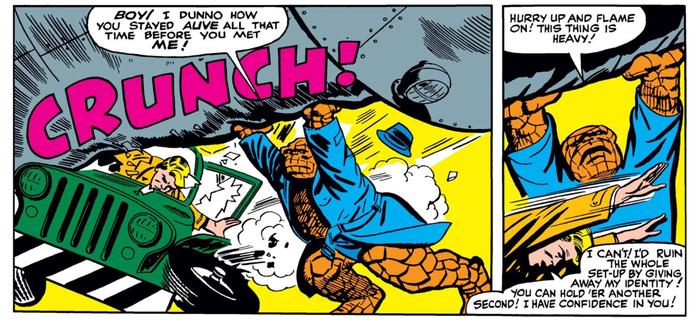
- The Thing Crashes the Scene: Despite all the setup about why Reed, Sue, and Ben can’t be involved, the Thing ends up showing up anyway. The story doesn’t even offer a satisfying explanation or worthy reason for this sudden cameo (teen romance does not cut it). It feels like they wanted to have their cake and eat it too as these stories are supposed to feature Torch and Thing.
- Reed and Sue’s Exclusion: The lengths the writers go to exclude Reed and Sue from these stories are exhausting. It’s better when they’re just “away” or otherwise unavailable instead of the story tying itself into knots to justify their absence. At this point, it feels forced.
- Underwhelming Artwork: The artwork doesn’t help matters. It feels flat and uninspired, much like the story itself.
- The Torch’s Investigation: Johnny’s approach to sleuthing is about as subtle as, well, a flaming human. Melting through walls and then welding them back together “discreetly” feels both lazy and laughable. Not exactly the most convincing spy work.

Not a problem… but…

Girls in Space: There’s an interesting, albeit frustrating, social commentary here. Within the Marvel Universe, Sue Storm is one of the first humans in space, yet NASA won’t even consider her for this astronaut role. This reflects the societal attitudes of 1965, where women were often excluded from such positions regardless of their capabilities. The cast accepts this limitation, but it’s easy to see (even from the writing of the time) how it shouldn’t have been this way. It’s a small but poignant window into the cultural mindset of the era.


Leave a Reply